Jumat, 28 Oktober 2011

Indonesia: Independent Investigation Needed Into Papua Violence

Ensure Proper Treatment of Detainees

Papuans peacefully calling for independence does not justify a deadly crackdown. President Yudhoyono has an opportunity to show Papuans that he’s concerned about their rights by seriously investigating these deaths.
Elaine Pearson, deputy Asia director at Human Rights Watch
(New York) – Indonesian President Susilo Bambang Yudhoyono should immediately establish an independent investigation into the deaths of at least three protesters and the ongoing violence in Papua, Human Rights Watch said today.

On October 19, 2011, Indonesian police and the army fired warning shots to disperse approximately 1,000 Papuans gathered for a peaceful pro-independence demonstration in the Papua provincial capital, Jayapura, after one of the leaders read out the 1961 Papua Declaration of Independence. In an ensuing crackdown by the security forces on the demonstrators, at least three people were killed and dozens were injured. Witnesses said several had gunshot wounds.

“Papuans peacefully calling for independence does not justify a deadly crackdown,” said
Elaine Pearson, deputy Asia director at Human Rights Watch. “President Yudhoyono has an opportunity to show Papuans that he’s concerned about their rights by seriously investigating these deaths.”


The involvement of security forces in the violence, as well as government denials of any wrongdoing, demonstrate the need for an independent investigation, Human Rights Watch said. While the military announced that the National Police were investigating the incident, the government has already said that the police and military acted appropriately. “The government did not find any abuse of power nor mismanaged approaches by the security officers,” said presidential spokesman, Julian Aldrin Pasha. “Police officers and security forces just accomplished their duties mandated by the state.”

Witnesses told Human Rights Watch that at about 2:30 p.m. on October 19, at the “Third Papuan Congress,” Forkorus Yaboisembut, chairman of the Papuan Customary Council, read out a 1961 Declaration of Independence, and said that he and Edison Waromi, the president of the West Papua National Authority, had been elected by the Congress as president and prime minister respectively of the “Democratic Republic of West Papua.”

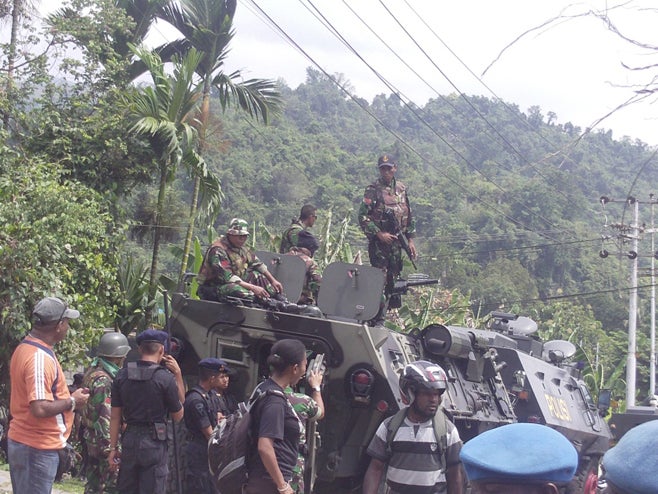
About 30 minutes later, the event concluded and the crowd started to disperse, but about 1,000 people remained in the field, talking, and socializing. At approximately 3:30 p.m., the police and military, who had deployed anti-riot trucks and surrounded the field since midnight the night before, began firing military assault weapons over the crowds and into the air.

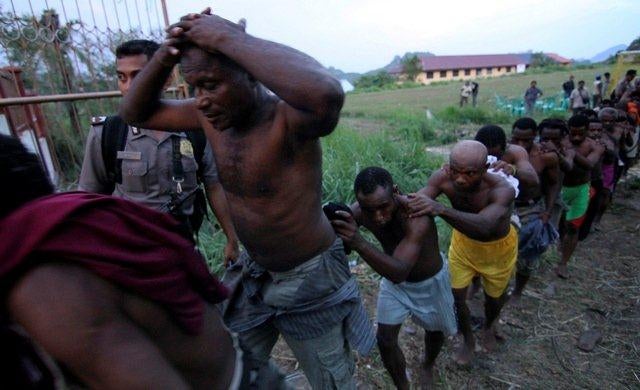
Witnesses said that most of the people in the field began running. Others stopped and surrendered, putting their hands up. The police then arrested approximately 300 people, ordering them to strip down to their underwear. Witnesses say that security forces pistol-whipped or beat those they arrested with rattan canes and batons, resulting in several injuries.

Many others fled into the woods near the field, with some using a road by a nearby school and military outpost. Witnesses said the police and military forces followed into the woods and there arrested numerous others.
The three reported deaths are:
  • Daniel Kadepa, 25, a law student at Sekolah Tinggi Ilmu Hukum Umel Mandiri. A witness said that Kadepa died from gunshot wounds to the head after soldiers fired on him as he was running away.
  • Max Asa Yeuw, 35, a member of the Penjaga Tanah Papua (Papua Land Guard or PETAPA).
  • Yakobus Samansabra, 53, a member of PETAPA, had bullet wounds to his torso, reportedly in the back.
Several other PETAPA members had gunshot wounds.
Indonesian security forces should abide by the United Nations Basic Principles on the Use of Force and Firearms, Human Rights Watch said. These which call upon law enforcement officials, including members of the armed forces, to apply nonviolent means before resorting to the use of force, to use force only in proportion to the seriousness of the offense, and to use lethal force only when strictly unavoidable, to protect life. The principles also provide that governments shall ensure that arbitrary or abusive use of force and firearms by law enforcement officials is punished as a criminal offense under their law.
Police have since released all of those arrested except for six men, five of whom were charged with treason, and one charged with possession of a sharp weapon:
  • Forkorus Yaboisembut, chairman of the Papua Customary Council, probably the most prominent pro-independence leader in Papua. Documents from Indonesia’s special forces, or Kopassus, leaked by Australian media in August, have revealed that Yaboisembut was on the top of the military’s watch list. Kopassus reportedly placed informants around Yaboisembut, including his neighbors and a journalist.
  • Edison Waromi, president of the West Papua National Authority.
  • Dominikus Surabut, secretary of the Papuan Customary Council in La Pago region.
  • Selpius Bobii, a social media activist, who organized the Papuan Congress. He eluded the police crackdown, but surrendered to police on October 20, accompanied by his lawyers and a Papuan journalist.
  • August M. Sananay of the West Papua National Authority.
  • Gat Wanda, a member of PETAPA, charged with possessing a sharp weapon.
The six men have had access to lawyers. Human Rights Watch has previously documented torture and ill-treatment of political detaineesby police and prison guards in Papua, and the failure of the government to hold those responsible to account.
“Past mistreatment of Papuan political prisoners means the safety of these detainees is also at risk,” Pearson said. “Those detained should be treated fairly and have access to Indonesia’s human rights commission and local human rights groups.”
This incident follows a string of violent incidents in Papua since July, including:
  • On July 31, a deadly clash between two local Papuan groups in Puncak Jaya, Papua, that claimed 17 lives. Leaders of both groups were planning to run for office for the same political party.
  • On August 1, the fatal shooting of three Javanese migrants and an Indonesia soldier, in Nafri, Jayapura. Police later arrested 15 Papuan villagers, including several children, in Horas Skyline village, Jayapura, allegedly beating and kicking the detainees. All but two of those detained have been released without charge.
  • On August 3, the fatal shooting of Pvt. Fana Suhandi, a member of the Army 753rd Battalion, as he guarded a military post in Tingginambut in Puncak Jaya. A sniper shot at a military helicopter that had arranged to transport his body from Puncak Jaya.
  • On August 22, in Mulia, the capital of Puncak Jaya, the fatal shooting by a sniper of an unarmed motorcycle taxi driver near a post of the Army 753rd battalion. Media reports say the victim may have been an army informer.
  • On August 23, Army Capt. Tasman M. Noer was stabbed to death by two men as he rode his motorcycle in broad daylight near his home in Abepura. A witness to the attack was beaten and hospitalized later the same day.
  • Since October 10, the killings of at least four people at the Freeport mine site in Timika, southern Papua. More than 2,000 workers stopped work in July and again in September demanding wage increases. Freeport has replaced workers on strike with other miners. On October 10, one of the striking workers was killed by police and several others injured. Several police officers and two journalists were also injured in the melee. Unidentified gunmen shot dead three non-Papuan workers on October 14.
  • On October 24, two unidentified men shot dead Mulia police chief, Dominggus Oktavianus Awes, in Mulia, Puncak Jaya. The men seized his pistol and used it to shoot him in the face.
Police investigations into these incidents have lacked transparency, and it has been difficult to gather information about the progress of investigations. Police efforts to hold the killers accountable have been frustrated by a lack of serious investigations, equipment, and manpower. In some areas, police have not gone to the crime scene or collected evidence due to concerns for their safety.
Documenting human rights violations during protests and other events is especially difficult because of restrictions, since 1962, on access to Papua for foreign human rights monitors and journalists. Human Rights Watch called on the Indonesian government to lift these restrictions. Human Rights Watch takes no position on the self-determination of the Papuan people.
“Police and military personnel have also been the victims of violence in Papua,” Pearson said. “But police investigations have been woefully inadequate, and there’s a need for independent investigations into this escalating violence.” 
Read more>>http://www.hrw.org/news/

Indonesia: Repeal New Intelligence Law


Overbroad Provisions Facilitate Repression

Indonesia should protect its citizens against terrorism and other threats, but the loose language of the intelligence law invites dangerous misuse. If the government wants a good intelligence law, it needs to start over.
Elaine Pearson, deputy Asia director at Human Rights Watch
(New York) – Indonesia’s recently enacted intelligence law could be used to impose repressive practices reminiscent of the Suharto era, Human Rights Watch said today. The Indonesian parliament, which passed the law on October 12, 2011, should repeal or amend the act to meet international human rights standards, Human Rights Watch said.
“Indonesia should protect its citizens against terrorism and other threats, but the loose language of the intelligence law invites dangerous misuse,” said Elaine Pearson, deputy Asia director at Human Rights Watch. “If the government wants a good intelligence law, it needs to start over.”

The new “Law on State Intelligence,” contains vague and overbroad language that could facilitate abuse, Human Rights Watch said. Article 6 broadly authorizes the Indonesian State Intelligence Agency (Badan Intelijen Negara, BIN) to engage in efforts “to prevent and/or to fight any effort, work, intelligence activity, and/or opponents that may be harmful to national interests and national security.”
“Opponent” is loosely defined as any “party from inside and outside the country engaged in effort, work, activities and action that may be detrimental to national interest and national stability.” BIN’s activities include efforts “to prevent, to deter and to overcome” – the meaning of which is vague – “every possible threat to the national interest and national security.”
Human Rights Watch said the law’s broad provisions could be used to legitimize government efforts to oppress political opposition. The phrases “national stability” and “opponents” were common terms during Suharto’s rule, from 1967 to 1998, invoked to justify crackdowns on pro-democracy activists, students, and human rights groups. Earlier draft versions of the law contained even more worrisome provisions, but they were removed as a result of advocacy by legal and civil society groups.
The new law also contains provisions that could be used to violate freedom of speech and the press, Human Rights Watch said. Articles 44 and 45 broadly state that “anyone” who deliberately or even negligently leaks confidential information about intelligence activities is subject to imprisonment. This language could easily be used to prosecute journalists, political opposition members, or human rights activists who publish information in the public interest about government abuses. For instance, journalists who produced media reports in August 2011 revealing that Indonesia’s military intelligence services were involved in the surveillance of activists, politicians, and clergy in easternmost Papua province might be subject to prosecution, Human Rights Watch said. The Papua revelations were based on hundreds of pages of internal military documents from 2006 to 2009 that Australian journalists had obtained. Indonesian authorities have a track record of using legal mechanisms to threaten journalists and civil society activists.
“Indonesian authorities have long used dubious laws as a pretext to harass civil society and silence government criticism,” Pearson said. “The new intelligence law will make repression even easier.”
The law grants BIN the power to conduct surveillance under a court order. Under Article 31, BIN has “special powers” to intercept communications and examine the flow of funds “strongly suspected for the financing of terrorism and separatism.” Because Indonesian courts are not adequately independent of political interference or BIN pressure, Human Rights Watch is concerned that granting BIN surveillance powers, even with court oversight, will allow the agency to use spying as a tool of political repression against opposition parties, political activists, and indigenous groups. Surveillance of civil society was common during the Suharto era.
Human Rights Watch called for improved and independent oversight of BIN. The new law establishes BIN as the chief intelligence body in Indonesia under the president’s direct control. Regulation of agency activities is subject only to the Office of the President and to parliamentary oversight. Until the law is repealed or revised the government should create an independent mechanism reporting to parliament to oversee the intelligence agency, such as an inspector general or ombudsman, Human Rights Watch said.
Another provision of the law could be misused to protect abusive members of the intelligence agency from prosecution or to provide the agency with legal cover if it decides not to cooperate in criminal proceedings, Human Rights Watch said. Article 17 states that BIN officers and their families are entitled to receive “protection” – a term that is not defined – when an intelligence officer is “carrying out his intelligence duties, efforts, work, activities and functions.”
Human Rights Watch said that lack of cooperation from BIN officials hindered the prosecution of former BIN director Maj. Gen. Muchdi Purwopranjono for the murder of human rights defender Munir bin Thalib in September 2004. After Purwopranjono’s acquittal, an independent team examining the trial in 2010 found that, among other problems, BIN had not cooperated or handed over key documentation that may have been necessary to support the prosecution’s case.
“Indonesian activists are rightly concerned about a law encouraging surveillance of their activities and one that could provide immunity to abusive intelligence agents,” Pearson said.

Related Materials: 
More Coverage: 

Kamis, 27 Oktober 2011

Peserta kongres dikejar hingga kamar Biara thumbnail
Pastor Neles Tebay (kiri) dalam jumpas pers kemarin
Kongres Rakyat Papua (KRP) III yang berakhir dengan deklarasi negara Federasi Papua Barat pada Rabu (19/10) berujung penangkapan terhadap para peserta, bahkan dilakukan hingga ke kamar-kamar frater, pastor, dan bruder di Abepura, Jayapura.
Tiga orang aparat berpakaian seragam dan preman hendak memasuki biara itu, namun dihadang oleh Pater Gonsa Saur OFM di tangga. Dia melihat aparat keamanan berpakain preman menerobos masuk ke kamar makan dan ruang tamu biara itu, kisah Pater Gonsa seperti dikutip pimpinan OFM Papua Pastor Gabriel Ngga OFM dalam jumpa pers bersama Rektor Sekolah Tinggi Filsafat dan Teologi (STFT) Fajar Timur, Abepura, Pastor Neles Tebay, Rabu (26/10) sore.
Diantara para aparat itu, kisah Pastor Gabriel, ada yang membawa senjata laras panjang dan pendek. Karena mendapat tekanan berkali-kali. Pater Gonsa akhirnya meminta mereka kalau bukan penghuni rumah boleh keluar kamar, akhirnya beberapa orang keluar. Namun banyak peserta kongres tetap bersembunyi di biara itu untuk menyelamatkan diri.
“Kamu boleh membawa mereka, tetapi jangan memukuli mereka,” kata Pater Gonsa kepada pihak aparat seperti dikutip Pastor Gabriel.
Seorang perempuan juga ditarik keluar dari biara. Seorang anggota aparat keamanan tiba-tiba menerobos ke lantai II. Tapi,  Pater Gonsa memintanya turun.

Sementara Pastor Neles Tebay, mengutip kesaksian salah seorang pastor projo menceritakan bahwa di Seminari Tinggi Yohanes Maria Vianey, yang dikelola Keuskupan Jayapura, banyak peserta kongres bersembunyi menyelamatkan diri. Aparat yang berusaha mencari peserta kongres  dan mereka menodongkan senjata api di kepala Pastor Yan You selaku pimpinan rumah. Tiga kali dia diancam ditembak.
“Kamu menyembunyikan mereka,” kata aparat-aparat itu. Tetapi Pastor Yan You tidak gentar. Dia malahan minta aparat untuk menembak saja dirinya. “Bunuh saja saya, tembak saya, ayo,” ujarnya.
Aparat kemudian mendobrak pintu, memasuki ruang dan mengeluarkan orang-orang yang  bersembunyi. Sementara para frater mengumpulkan peserta kongres yang lari menyelamatkan diri di aula. Frater-frater juga mengikhlaskan kamarnya sebagai tempat perlindungan, kata imam itu.
Pastor Neles mengatakan para frater mengenakan jubah mereka dan menjaga peserta kongres. Tetapi ketika aparat datang, beberapa orang menyerahkan diri dan digelendang keluar oleh aparat. Melihat itu para frater pun berpesan agar para aparat tidak berlaku kasar kepada peserta kongres.
Ia melaporkan para peserta kongres bersembunyi di Seminari Tinggi Yohanes Vianey milik Keuskupan Jayapura, Asrama Katolik “Tauboria” untuk mahasiswa, Seminari Tinggi Interdiosesan “Yerusalem Baru” milik lima Keuskupan Se-Tanah Papua, kampus STFT Fajar Timur.
Artikel terkait: Kronologi peristiwa

Gereja, aktivis desak SBY tangani serius Papua

Gereja, aktivis desak SBY tangani serius Papua thumbnail
Beberapa pastor Protestan yang terus menyuarakan perdamaian di Papua (Dok)
Komisi HAK KWI dan Persekutuan Gereja-gereja di Indonesia (PGI) bersama para aktivis HAM dari 35 LSM desak Presiden Susilo Bambang Yudhoyono untuk segera menangani kekerasan di Papua.
“Kami, warga negara Republik Indonesia meminta dengan tegas kepada Presiden Republik Indonesia Susilo Bambang Yudhoyono untuk menyelesaikan persoalan di Papua dengan membangun dialog sejati yang damai yang menghormati martabat dan hak budaya rakyat Papua,” demikian pernyataan bersama mereka yang disampaikan dalam konferensi pers di kantor KontraS (25/10).
Mereka menyatakan amat mengkhawatirkan perkembangan situasi penegakan hak asasi manusia di Papua.
“Kami meminta presiden memerintahkan Panglima TNI segera menarik seluruh personel TNI non organic  dari Tanah Papua,” lanjut pernyataan itu.
Forum itu juga meminta presiden memerintahkan Kapolri Jenderal Polisi Timur Pradopo agar segera melindungi dan menciptakan rasa aman di tengah rakyat Papua.

“Kami menuntut adanya penyelidikan perkara secara akuntabel, mengedepankan rule of law dan prinsip-prinsip hak asasi manusia atas setiap praktik pelanggaran HAM yang terjadi di Papua,” lanjut pernyataan itu.
Mereka juga menyatakan dukungan dialog damai bagi Papua serta selalu memberikan dukungan moriil kepada saudara-saudara di Papua untuk tetap berjuang meraih kesetaraan di negeri ini.
Papua menjadi ladang subur kekerasan, kata mereka, ketika negara lebih memilih untuk menghadirkan aparat keamanan dalam skala masif, ketimbang meningkatkan derajat warga Papua setara dengan warga negara Indonesia lainnya.
Mereka mencontohkan, dua orang buruh PT. Freeport  tewas dalam aksi demonstrasi serta seorang intel polisi kritis telah menunjukkan fakta aktual yang tidak bisa kita abaikan.
Ratusan orang ditangkap, 3 tewas dan 6 orang lainnya dituduh telah melakukan kegiatan subversif, juga penembakan di Timika yang menyebabkan 3 tewas dan 1 kritis, serta kasus terakhir Kapolsek Mulia, Puncak Jaya juga meninggal akibat ditembak oleh pelaku yang belum diketahui.

Rabu, 26 Oktober 2011

Rudd called on to launch Indon inquiry

Foreign Minister Kevin Rudd has been urged to launch a Senate inquiry into Australian aid to Indonesia, with several people killed at a peace rally in West Papua.

About 5000 people attended the Papuan Peoples Congress earlier this month to discuss human rights issues and declare independence from Indonesian rule.
But Joe Collins, secretary of the Australia West Papua Association, said police and the Indonesian military used canes and batons to attackpeople.
He said six West Papuan people were killed in the incident and another six were charged with treason.
International news agencies are reporting that five people were killed but the Jakarta Globe newspaper also says six.
Mr Collins said the government should call on Indonesia to halt all military operations in West Papua to prevent further bloodshed.
"We also urge the government to hold an inquiry into how Australian aid and training to the Indonesian military impacts on the life of the West Papuan people," Mr Collins said.

He said the situation was deteriorating rapidly in the Indonesian-controlled province.
President of the Australian branch of the International Commission of Jurists, John Dowd, said Indonesia should stop denying West Papua its independence.
"There is a limit to how far you can suppress the will of a people," Mr Dowd told reporter in Sydney on Thursday.
"The main problem with West Papua is suppression."
Mr Dowd said Australia needed to do more to pressure Indonesia to stop human rights abuses in West Papua.
He emphasised the need for a free press and media scrutiny of the region.
"If Indonesia has nothing to hide, then why suppress the press?" Mr Dowd said.

Senin, 24 Oktober 2011

CSW urges Indonesia to establish dialogue with Papuan people following brutal crackdown by military in West Papua


Christian Solidarity Worldwide (CSW) today urged the Indonesian Government to take urgent steps to address the grievances of the Papuan people after tension escalated in West Papua last week.

On 19 October, the Indonesian military and police brutally suppressed a peaceful Papuan People’s Congress after delegates raised the Morning Star flag, a symbol of West Papua’s resistance to Indonesian rule, and declared independence. At least six Papuan people were killed and six have been charged with treason. Several hundred were initially arrested, although many have since been released.
According to media reports, the police and military fired shots into the air to disband the gathering, but some soldiers reportedly pointed weapons directly at people. Delegates were beaten by the police and soldiers with batons, bamboo poles and rifle butts. Security forces raided a nearby Catholic seminary and priests’ residence.

In a chilling warning, the police chief in Jayapura, Imam Setiawan, told the media, “Whoever supports separatism or subversion activity, I will do the same as yesterday. I’ll finish them.”
Rev Socratez Sofyan Yoman, Chairman of the Alliance of Papuan Baptist Churches, told CSW, “We call on the Indonesian authorities to open the door for peaceful dialogue between the Papuan representatives and the Indonesia Government. Dialogue must take place without preconditions and be mediated by  a neutral party. The Indonesian military and police must respect the Papuan people’s dignity and rights and stop the violations. As church leaders we strongly support genuine dialogue between the Indonesia Government and West Papuan leaders to solve West Papua’s problems.”
CSW’s Advocacy Director Andrew Johnston said, “It is overwhelmingly clear that the Indonesian military and police used disproportionate force against a peaceful gathering, flagrantly violating human rights and brutally beating and killing unarmed civilians. As a member of the UN Human Rights Council, Chairman of the Association of South-East Asian Nations (ASEAN) and a member of the G20, Indonesia has a responsibility to uphold the rule of law, protect human rights and respect international law. The tragic and bloody escalation in tensions serves as a wake-up call to Indonesia and the international community, that the grievances of the Papuan people must be addressed. Indonesia cannot continue to suppress the Papuan peoples’ freedom of expression as it did last week. Instead, a dialogue process is urgently needed, in which concerns about human rights, health care, education, development, environmental degradation and the impact of migration should be discussed, and Papua’s political future negotiated. We urge the Indonesian government to take the following steps to build confidence with the Papuan people, which has been further damaged by last week’s brutal crackdown: release all political prisoners, lift the ban on raising the Morning Star Flag, demilitarize Papua by reducing the military presence, and start to address the basic needs and rights of the Papuan people. The time for genuine dialogue is now.”
For further information or to arrange interviews please contact Kiri Kankhwende, Press Officer at Christian Solidarity Worldwide, on +44 (0)20 8329 0045 / +44 (0) 78 2332 9663, email kiri@csw.org.uk or visit www.csw.org.uk.
Christian Solidarity Worldwide (CSW) is an organisation working for religious freedom through advocacy and human rights, in the pursuit of justice.

Gillard should say sorry, to West Papua

 Since August 2011, two peaceful protests have taken place in the West Papua province of Indonesia.
At the pro-independence rallies near Jayapura attended by around 20,000 people, a total of 5 people have been shot dead by police aggressively seen dispersing the crowd. It has been reported that over 300 people were arrested in the raids. Similarly, at a month-long strike at the Grasberg mine complex – jointly owned and operated by Anglo-Australian Rio Tinto and the American miners Freeport – a total of 7 people have been killed by Indonesian security forces. It is estimated around 12,000 workers are presently on strike at the mine.
Last night the AFP reported that an Indonesian police chief was shot dead:
Mulia city police chief Dominggus Awes was at the local airport, southwest of the provincial capital Jayapura, when two men began beating him, grabbed his gun and shot him with it, Papua police spokesman Wachyono told AFP.

“They punched him, took his pistol and shot him in the neck and face, hitting his nose. He was taken to a hospital and later died from his injuries,” he said.
 According to a report filed with West Papua Media, the Indonesian government are satisifed with the use of force at the protests:
Djoko Suyanto, the coordinating minister for political, legal and security affairs, also defended the government’s tactics, according to Antara.
“The police raided the rally because it was considered as a coup d’etat,” Djoko said. “They declared a state within a state and did not recognize the president of Indonesia.”
Australia has a long history with the people of West Papua, culminating in a decision by the John Gorton government on May 29, 1969. As I argue below, Australia betrayed the people of Papua at that time, and now Prime Minister Julia Gillard must seriously consider issuing a formal apology to its indigenous people.
How Australia neglected the Papuans
New Guinea, geographically as well as historically, is Australia’s closest relative. Separated from the mainland during the last glacial period, the waters filled in what now separates them: about 152km of the Torres Strait.
While Australia and New Guinea both have enviable mineral stores, economic and political exploitation has left the latter as home to many of the poorest people on Earth. New Guinea is also an island of two histories.
The eastern half forms the independent state of Papua New Guinea – a status it has enjoyed since breaking from Australia in 1975. With its natural resources of oil and industrial metals, Papua New Guinea has long been exploited for its minerals by Australian firms at places like Ok Tedi and Bougainville.
The western half of New Guinea has had a lesser-known but equally tragic history centred around the Jayawijaya Mountain, home to the Amungme, and farther downstream, the Kamoro people. As with much of East Asia, the indigenes were under Dutch rule when a geological expedition in 1936 located a significant ertsberg (ore mountain) deep in the southwestern highlands. World War II intervened, and the Japanese claimed Indonesia and some of the western parts of New Guinea.
Following defeat in the war, the Japanese were marshalled back to their home territory, and Dutch colonialism resumed. Importantly, when Indonesian independence was obtained from the Dutch in 1949, few knew of the ertsberg (mineral ore) hidden deep in West Papua’s wilderness.
The Dutch began a ten-year Papuanisation programme in 1957 that would see West Papua handed back to the indigenes, and would create the independent state of West Papua around 1972.
Despite multiple territorial claims, the ore mountain lay dormant for over 20 years.
On March 6, 1959, the New York Times reported the presence of alluvial gold in the Arafura Sea just off the coast of West Papua. Reminded of their earlier discovery, Dutch geologists were said to be returning to the ore mountain, now simply known as Ertsberg.
Independence denied
The indigenes, meanwhile, as part of their programme toward independence, established a Papuan National Council and provisional government as well as their own military, police force, currency, national anthem, and flag. At the time, West Papua’s independence was due before the United Nations Decolonisation Commission, and representatives took part in various cultural and political activities throughout the region. By December 1, 1961, the West Papuan “Morning Star” flag had been raised alongside the Dutch for the first time. Many assumed that independence was imminent.
Unbeknown to both the indigenes and the Dutch, US mining company Freeport-McMoRan Copper and Gold was negotiating directly with Suharto – at the time an Indonesian army general – for a small group of its experts to prospect this ore mountain. The path into West Papua through Suharto promised to be fruitful for Freeport, since its board was stacked with the Rockefeller’s Indonesian oil interests who already were versed in the general’s way of doing business. An exploration agreement was reached, and soon after a geologist from Freeport was forging his way through the wilderness toward Ertsberg.
West Papua was about to change hands again.
Armed with Chinese and Soviet weapons, as well as an increasingly public friendship with the communists, Indonesia declared war on the Netherlands. To protect Western interests from the threat of communism, on August 15, 1962, the United Nations and the United States orchestrated a meeting between Dutch and Indonesian officials during which interim control of West Papua was signed over to Indonesia.
Six years of UN interregnum followed, after which a plebiscite would decide whether to form a separate nation or integrate into Indonesia. All 815,000 West Papuans were to vote in an Act of Free Choice.
To ensure a favourable outcome, the Indonesians worked to suppress Papuan identity. Raising the West Papuan flag and singing of the national anthem were banned, and all political activities were deemed subversive. Indonesia ruled through force, for self-interest. Alarmed by ongoing media reports, on April 5, 1967, in the British House of Lords, Lord Ogmore called for a UN investigation. By early 1968, with Suharto having assumed the presidency of Indonesia, a US consular visit almost unanimously agreed that “Indonesia could not win an open election” in West Papua.
West Papua still wanted its independence.
In a desperate attempt to secure West Papua’s right to self-determination, two junior politicians crossed the border into Australian-administered Papua and New Guinea on May 29, 1969. They carried damning evidence of Indonesian repression; the hopes of a yet-unformed nation rested on the politicians reaching the UN. As Australia and its allies were amenable to Indonesian control of West Papua, the two were imprisoned upon crossing the border until after the referendum.
Their brave plea silenced.
Between July and August 1969, less than a quarter of one per cent of the population – some 1,026 West Papuans – signed the country’s freedom over to Indonesia. The election, held under the aegis of the UN, was far from an act of free choice. The following day West Papua was declared a military operation zone, the local people’s movement was restricted, and expression of their national identity banned under Indonesian law.
Poor, neglected West Papua.
Who gained from Australia’s betrayal of the Papuan people?
Today the social and economic condition of the indigenous Amungme and Kamoro poses fundamental human rights concerns. Although Freeport-Indonesia directly or indirectly employs a large number of West Papuans and is regularly Indonesia’s biggest taxpayer, in 2005, the World Bank found that Papua remained the poorest province in Indonesia. With a marked rise in military personnel and foreign staff has come a number of social issues, including alcohol abuse and prostitution such that Papua now has the highest rate of HIV/AIDS in Indonesia.
Indonesian control of West Papua has been characterised by the ongoing and disproportionate repression of largely peaceful opposition. Few sustained violent interactions have occurred; however, in one major conflict in 1977, more than 1,000 civilian men, women, and children were killed by the Indonesian military in Operasi Tumpas (“Operation Annihilation”) after a slurry pipe was severed and partially closed the Ertsberg mine.
While the level of violence is difficult to establish, academics at the Centre for Peace and Conflict Studies at the University of Sydney maintain that up to 100,000 West Papuans may have been killed since Indonesian occupation.
They call what’s happening to West Papua “slow-motion genocide”.
What can Australians do now?
Australians must pressure their local MPs to call for an international inquiry into the killing of 12 Papuan civilians during peaceful protests since August 2011, as well as discussing the prospect of Australia issuing a formal government apology to the Papuan people for putting an end to their legitimate claim to sovereignty in 1969.
For further information, see my series of four essays on West Papua, published on Al Jazeera over the past month. Or check West Papua Media.
Follow NAJ Taylor on Twitter: @najtaylor